


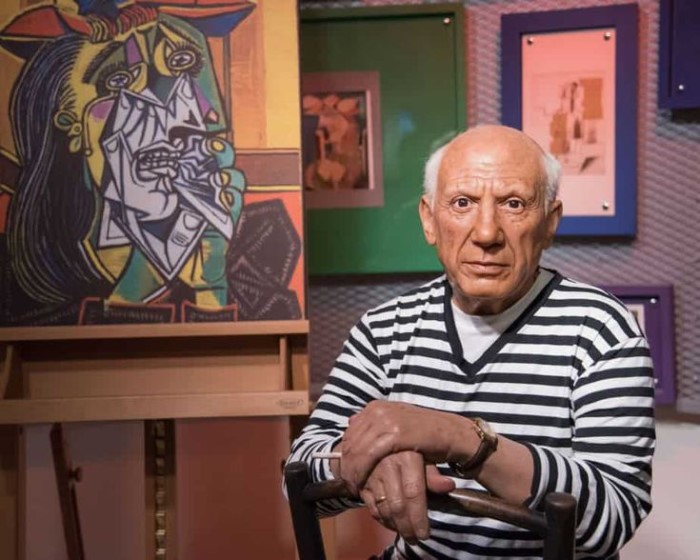
When we face a difficult problem, our brain often looks for a linear solution. But what if we could break the problem down into geometric shapes, rearrange them, and see the whole picture from all angles at once? This is exactly how the 20th-century genius Pablo Picasso worked. Picasso’s Cubism is not just an art movement; it is a unique strategy that trains creative thinking and teaches us how to think outside the box.
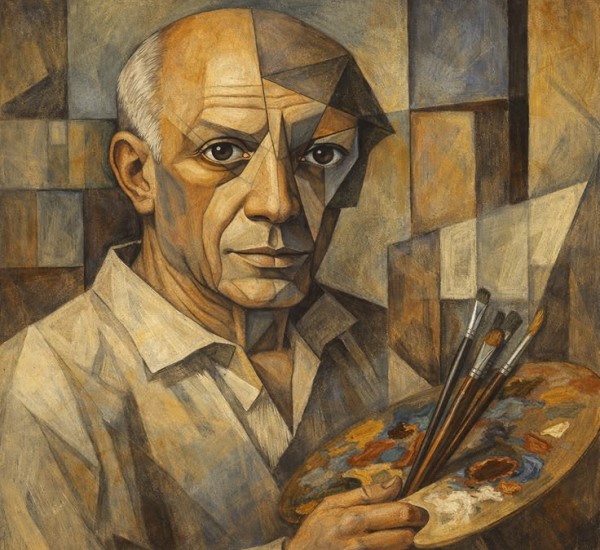
The story of Pablo Picasso begins on 25 October 1881 in the Spanish city of Málaga. According to one legend, he was born so weak that the midwife thought he was stillborn, and it was only the smoke from his uncle’s cigar—a doctor—that made the baby cry out. This first victory became a symbol of his entire future destiny.
His father, Don José Ruiz Blasco, was an art teacher and curator of the local museum. He became Pablo’s first mentor, laying the foundations of iron discipline. There is a popular myth that the boy’s first word was not ‘mama’ but ‘piz’ – short for ‘lápiz’ (pencil). Pablo began drawing before he could speak clearly, and his father immediately recognised his son’s genius.
By the age of 13, the teenager was already demonstrating incredible skill. Pablo enrolled at the Academy of Arts in Barcelona, where he completed an examination task in a single day that others were given a month to finish. His technique was flawless, but therein lay the trap.
Picasso’s true breakthrough came not when he achieved perfection, but when he dared to abandon it. He realised that technical perfection was merely a copying of reality, not the creation of something new. His spirit, nurtured within the strict confines of academicism, broke free when he realised that the true essence of an object cannot be conveyed through a single, fixed perspective.
This journey from academic to rebel taught him a golden rule that is used today in critical thinking and business strategies:
«Learn the rules like a pro, so you can break them like an artist»
Cubism emerged around 1907, when Picasso, together with Georges Braque, began to challenge traditional notions of perspective. Their style was heavily influenced by African art: masks and sculptures inspired a new approach – not to copy reality, but to convey its essence through simple, almost geometric forms.
Picasso’s Cubism is a system where chaos is structured, and the destruction of the old perspective becomes the birth of a new reality. His example proves that to find solutions to problems that seem impossible, one must have the courage to reject what one once considered the only correct approach.
Чому Пікассо став тим, ким він став?
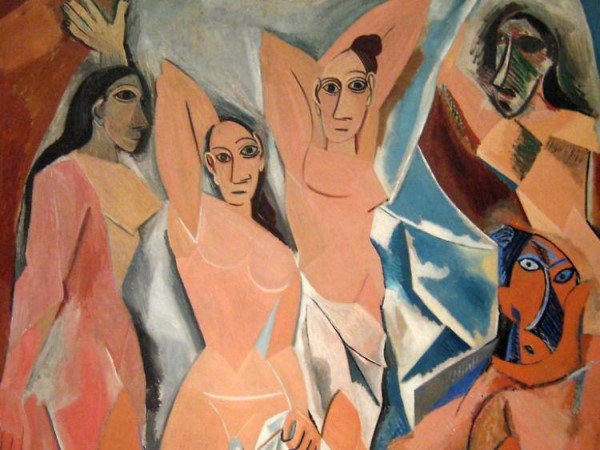
The painting Les Demoiselles d'Avignon, painted by Pablo Picasso in 1907. In this work, Picasso abandoned classical perspective for the first time: the faces resemble African masks, and the figures appear to be broken down into flat planes.
Чому Пікассо став тим, ким він став?
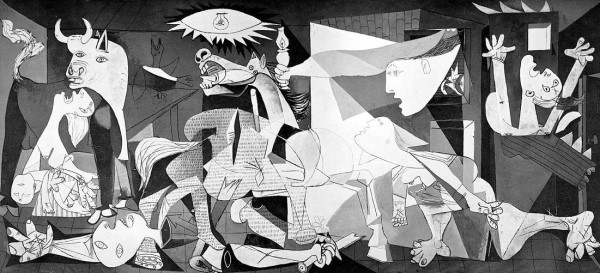
This is Pablo Picasso’s painting Guernica, created in 1937, which depicts the tragic events of the Spanish Civil War. The painting demonstrates how Cubism can convey not only form but also emotion – the chaos, pain and tragedy of war.
Чому Пікассо став тим, ким він став?
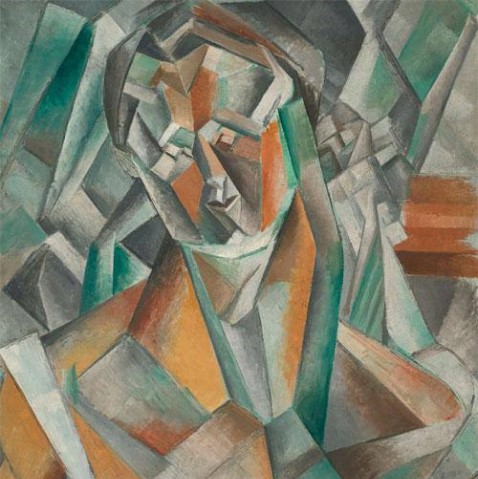
The painting Seated Woman (*Femme assise*), created by Pablo Picasso in 1909. It illustrates the key principle of the style: a single object depicted simultaneously from different angles.
Picasso’s Cubism invites us to shift from critical thinking to spatial thinking. Here are 5 steps on how to apply this approach in life, business or education:
- Break it down. Break the problem down into smaller parts. Don’t try to solve everything at once.
- Multiple perspectives. Try to view the problem from the perspective of different people at the same time. How does your client see it? How about a competitor? And what about someone from another country? This helps you look at the problem from different angles.
- A rejection of correctness. In Cubism, there is no ‘right’ side. It is the same in life.
- The Geometry of Logic. Transform emotions into structures.
- A collage of solutions. Picasso was the first to start incorporating pieces of newspaper and string into his paintings. Make use of external tools. For example, learning English could be the very missing piece that opens the door to international case studies.
To make learning English as multifaceted as the master’s paintings, memorise these phrases and words:
- Perspective /pəˈspektɪv/
- Out-of-the-box thinking
- To break the mold
- Multi-faceted /ˌmʌltiˈfæsɪtɪd/
Overcoming the language barrier often requires a different approach: instead of simply memorising rules, start combining conversation practice, watching films and reading.
Interesting facts about Pablo Picasso
A constant experimenter. His way of life revolved around constantly teaching himself new things: from ceramics to sculpture.
The wealthiest artist. Unlike many of his peers, he became a millionaire during his lifetime because he knew how to market his work – a perfect example of how creative thinking works in marketing.
Чому Пікассо став тим, ким він став?
What to watch or read?
- 🎬 TV series: ‘Genius: Picasso’ (National Geographic). Antonio Banderas brilliantly captured the artist’s complex character. Watching it in the original language is a great way to improve your English. Watch
- 📖 Book: Picasso: Creator and Destroyer (Arianna Huffington). This is not merely a biography, but a profound psychological exploration of how the artist’s turbulent personal life fuelled his creative revolution. Arianna Huffington skilfully unravels the paradox of genius: how a man capable of incredible tenderness in his painting could be so destructive in his relationships with those closest to him.
Coco Chanel: A Success Story, Style Tips and Quotes in English
Pablo Picasso taught us that the world is not flat. If you can’t find a way out, perhaps you’re simply looking at it from the wrong angle. Solving problems requires flexibility. In today’s world, those who succeed are those who know how to shift their perspective – in their thinking, their work and their communication. And it is language that often serves as the tool that opens up new perspectives.
Join the SARGOI English-speaking community to learn to see opportunities where others see only walls!