



Our attention flits between browser tabs, notifications and short videos. We’ve grown accustomed to ‘clip-style’ thinking: we open a text and, within seconds, we’re already reaching for another tab. But it turns out that this diagnosis of humanity was made long before the advent of the internet. Its author was Charles Baudelaire.
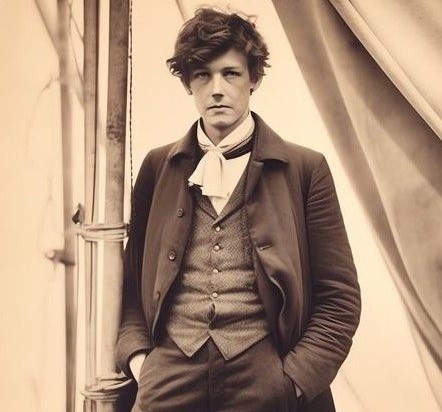
Baudelaire’s story is that of a man who was the first to feel the shock of modernity. He was born in 1821 in Paris, a city that was, at that very moment, transforming into a seething cauldron of industrialisation. His father died when the boy was six, and his stepfather, a general, tried to curb his stepson’s rebellious spirit with strict discipline. But Baudelaire chose a different path – that of the flâneur (from the French flâneur – one who wanders aimlessly).
Baudelaire spent his inheritance on silk gloves and rare books, yet at the same time he was one of the first to see the dark side of progress. His magnum opus – the poetry collection Les Fleurs du mal (The Flowers of Evil) – became a revolution. He showed that beauty can be found in the grotesque, and truth in the details we usually ignore.

Lesya Ukrainka was a modernist who introduced existential and mythological themes into Ukrainian literature.
- The tyranny of the new. Baudelaire wrote about a state of ennui amidst a surplus of impressions. Today we call this information overload. When we chase after every new piece of news, we lose the ability to analyse the root causes.
- The art of observation. In a world of fragmented thinking, we look but do not see. Depth is the ability to dwell on a single idea. For example, reading a page and not turning it until a thought of one’s own has formed.
- Superficial progress. Baudelaire was sceptical of the idea that new technologies automatically make people better. Today, this manifests itself in the form of hundreds of educational apps that create the illusion of progress without any real results.
This problem is evident even in the way we learn. In the SARGOI English-speaking community, we often see students trying to learn English overnight, relying on ‘magic’ apps that promise results in just five minutes a day. Baudelaire would say: ‘You are losing depth.’ And we say: “There is no magic wand.”
Effective learning is always about overcoming resistance.
- The flashcard approach: learn 10 words from the list and forget them the next day.
- The Baudelairean approach: understanding the context, grasping the etymology of a word, and using it in a lively discussion. This is what conscious learning is all about.
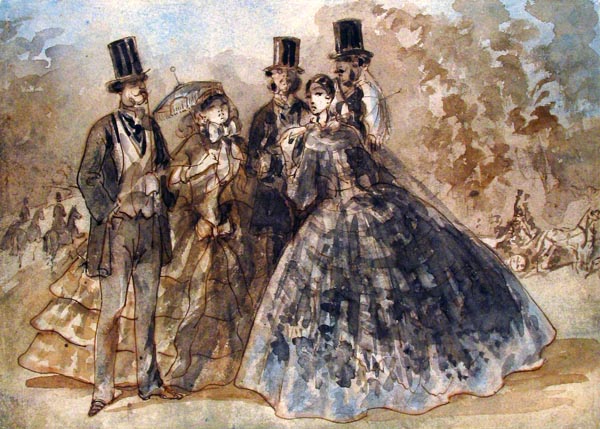
To describe your experience of immersing yourself in English, use these phrases:
- Deep dive - in-depth exploration (of a subject or language learning).
- Attention span - the ability to concentrate (something we are rapidly losing these days).
- To read between the lines - to read between the lines (to pick up on the underlying meaning).
- Cognitive overload - cognitive overload (when there is too much information overload).
- Mindfulness - mindfulness (the key to overcoming tunnel vision).
Charles Baudelaire was not only a poet, but also one of the finest art critics of his time. He could stand in front of a single painting for hours, studying every brushstroke. His ability to concentrate was phenomenal.
What to watch and read?
POETRY
Les Fleurs du mal (The Flowers of Evil)
Charles Baudelaire
Try reading the bilingual edition (English/Ukrainian). This trains your brain to see how the same profound thought is transformed across different linguistic systems.
FILM
‘Charles Baudelaire: The Poet's Life’
A wonderful opportunity to practise your listening skills in English whilst immersing yourself in the master’s biography. Pay attention to the vocabulary used to describe his character and lifestyle.
Charles Baudelaire teaches us to pause and look deeper. If you feel that your learning has become superficial, perhaps it’s time to change your approach.
Join SARGOI – we don’t just teach words, we teach deep thinking in English!