

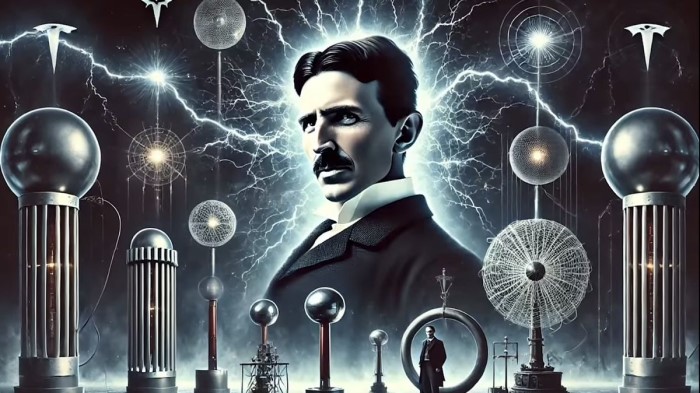
We tend to think that we live in the era of Elon Musk or Steve Jobs. But the truth is that, technically, we still live in the era of Nikola Tesla, a genius who was ahead of his time. Every time we turn on the light, charge our smartphone wirelessly, or use Wi-Fi, we are using ideas that were born in the mind of one man over a hundred years ago.
Tesla was not just an inventor. He was a visionary whose tragedy was that he was born too early. For Ukraine in 2026, which is building a new energy and technological reality, Tesla's story is a textbook on sustainability, innovation and belief in ideas that seem impossible.
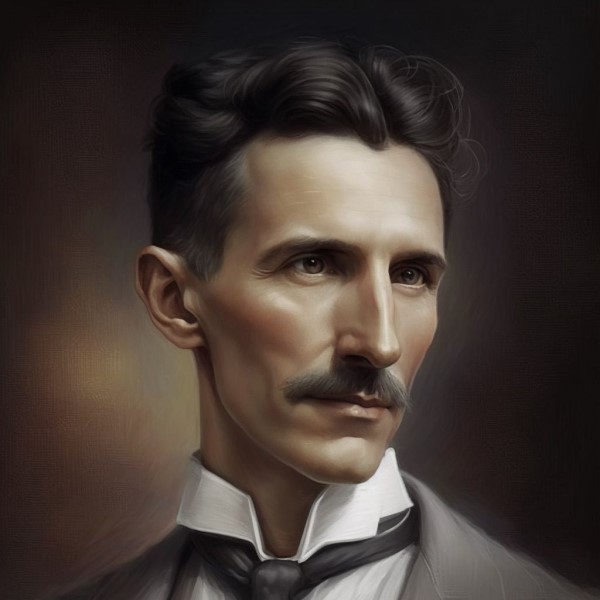
Nikola Tesla grew up in a family where deep faith and strict intellectual discipline intersected. His father, Milutin, was an erudite Orthodox priest who spent hours training his son's memory with complex exercises and dreamed that he would continue the spiritual dynasty. However, Tesla himself always insisted that he inherited his true inventive gift from his mother, Juka Mandic. She had a genius for engineering and was constantly crafting ingenious devices to make the difficult life of a large family a little easier.
To understand Tesla, one must understand the era of the late 19th century. It was a time of rumbling steam engines, soot and gas lamps. Electricity was a luxury for almost everyone. When the young Serbian immigrant arrived in New York in 1884 with four cents in his pocket, America was experiencing an industrial boom. Thomas Edison, the king of direct current (DC), ruled the roost. Edison was a brilliant businessman who built power stations in city centres to supply electricity to the homes of the wealthy. But direct current had a flaw: it could not be transmitted over long distances without loss.
Tesla offered an alternative: alternating current (AC). It was not just a technology, it was a revolution. Alternating current could be transmitted over hundreds of kilometres, lighting not only the mansions of New York, but also the poorest villages.
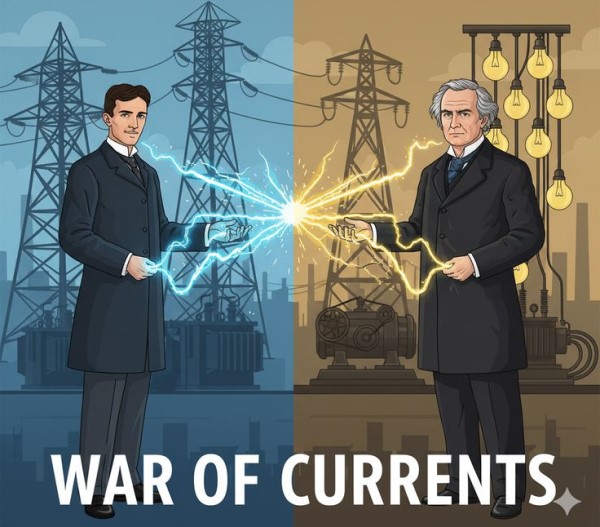
This conflict, known as the War of Currents, became a clash between two philosophies: Edison's corporate control and Tesla's decentralised accessibility. Tesla won technically (our sockets still deliver AC), but lost financially by giving up royalties to save Westinghouse's company. This act shows his essence: the progress of humanity was more important to him than billions.
Tesla received about 300 patents worldwide. But here are four major success stories and innovations that were born in his laboratory and without which we would not be able to live today.
⚙️
1. AC Induction Motor
When: 1887–1888
How it was: Before Tesla, electric motors were noisy, sparked, and broke down quickly. Tesla invented a motor that used rotating magnetic fields. It was such an elegant solution that scientists at the time did not initially believe it was possible without complex mechanical commutators.
How it helps us today: This motor is in your fridge, washing machine, factories, lifts, and, of course, it's the tech behind the first Tesla electric cars and modern electric motors in general.
📡
2. Radio (Yep, Tesla, not Marconi)
When: 1893–1897
How it happened: Italian Guglielmo Marconi (who received the Nobel Prize in Physics in 1909 for his contribution to the development of wireless telegraphy) used Nikola Tesla's patents for his experiments. Tesla demonstrated the principles of radio communication as early as 1893. Historical justice was only restored in 1943, when the US Supreme Court officially recognised Tesla's priority.
Use today: All wireless data transmission, from FM radio in your car to Wi-Fi, Bluetooth and 5G in your smartphone, is based on the principles of frequency tuning discovered by Tesla.
🛸
3. ‘Teleautomat’ (the first radio-controlled drone)
When: 1898
How it happened: At an exhibition in Madison Square Garden, Tesla shocked the audience by launching a small boat in a pool. The boat sailed, turned and flashed lights without any wires — Tesla controlled it using radio waves. People thought it was magic or that there was a trained monkey inside. Tesla called it a ‘teleautomaton.’
Use today: It was the grandfather of all modern drones and unmanned aerial vehicles. For Ukraine today, this technology is one of the most important in both civil logistics and defence.
💧
4. Hydroelectric power plant at Niagara Falls
When: 1895
How it happened: This was the first major triumph of alternating current. Tesla and George Westinghouse built the first large commercially successful long-distance alternating current hydroelectric power plant. The energy of the water was converted into electricity, which was transmitted to the city of Buffalo, 35 km away. Newspapers wrote about it as ‘man's victory over nature.’
Benefits today: Tesla was the first to say that we should not burn fuel to obtain energy when we have the power of water, wind and sun.
Learning English through Tesla's biography means immersing yourself in discussions about technology in English, the language of science and business.
- Visionary. More than an inventor. This is someone who sees the future. Tesla was a visionary, Edison was an inventor.
- Obsolete. A word that every techie fears. Tesla made steam engines obsolete by introducing electric ones.
- Current. AC (Alternating Current) is alternating current. But Current events are current events.
- Patent pending. A phrase Tesla used hundreds of times. This is the status of awaiting legal protection for an invention.
- Disruptive technology. A modern term that perfectly describes what Tesla did. It is technology that radically changes the rules of the game.
Useful resources for research (Live Links):
Tesla Museum in Belgrade An official museum with archives, drawings, and personal belongings. A unique source of truth.
FBI Records: The Vault For detective story enthusiasts, there are declassified FBI files about what happened to Tesla's papers after his death (read them in English for added enjoyment).
Cartoons as a motivational tool in foreign language teaching: between emotion and effectiveness
Tesla's history and inventions are not about the past, they are about our present and future.
- Energy independence. Tesla dreamed of decentralised energy. In 2026, as Ukraine develops distributed generation and smart grids, we are implementing his ideas.
- Technology as the future. Tesla showed that resources are not coal or oil, but intelligence. Ukraine, as an IT hub and centre of military technology, is the direct heir to this approach.
- Dignity and selflessness. Tesla terminated a multi-million dollar contract to ensure the survival of alternating current technology. This teaches us that sometimes values are more important than profit.
For the English-speaking community of SARGOI and everyone who studies English for IT and engineering, English for scientists, Tesla's biography is a must-read. It teaches not only technical vocabulary, but also critical thinking: to check facts, not believe myths, and always seek light, even when surrounded by darkness.