


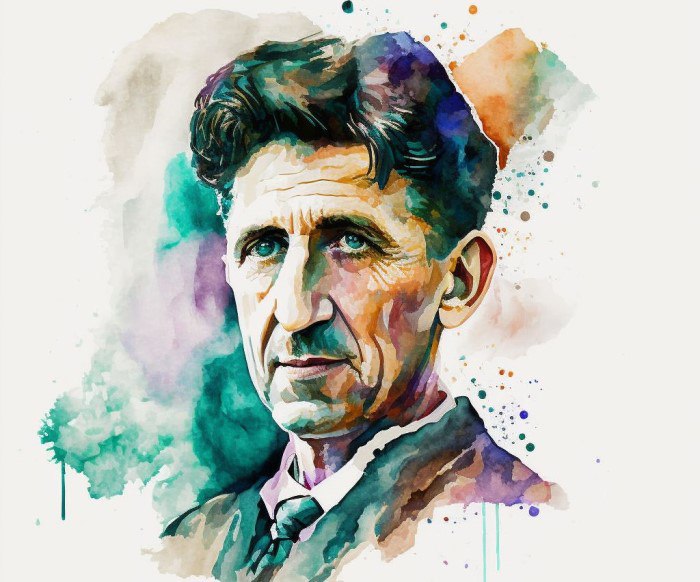
George Orwell has long gone beyond the school curriculum and become a symbol of the struggle for critical thinking in a world of manipulation.
We often perceive George Orwell as the author of gloomy predictions, which, unfortunately, too often come true. But he was not a prophet; he was a master of deconstructing lies. Orwell taught the world that freedom begins not with slogans, but with purity of language.
For the modern world, where information manipulation has become commonplace, George Orwell remains a leading intellectual guide. His work is a manifesto of how the influence of language on thinking shapes our reality.

George Orwell (Eric Arthur Blair) was born in 1903 in British India, at the heart of an imperial system built on control and hierarchy. He knew well how power worked: his education at elite schools and his poor background sharpened his sense of social injustice.
His service in the colonial police force in Burma became a moral turning point for him. Orwell left the service, realising that the empire forced people to be part of a repressive mechanism. This experience formed the basis of his essay Shooting an Elephant, one of the most honest texts about the violence of the system against the individual.
Orwell consciously chose the path of truth, even if it was uncomfortable. He lived among the homeless in London and Paris to understand the nature of poverty, and fought against fascism in Spain, where he nearly died. It was there that he realised that totalitarianism can hide under any flag. His books are the result of his life experiences, where every word is backed up by his own blood and honesty.
Vocabulary of Freedom
Orwell's English for intellectuals is concise, precise and free of clichés. That is why reading classics in their original language, as exemplified by Orwell, is an effective way to expand your vocabulary and analytical thinking. Let's take a look at some key concepts that will help you understand his philosophy and enrich your vocabulary:
- Newspeak. A fictional language from the novel ‘1984’, created to limit the scope of thought. Lesson: the fewer words we know, the easier it is to manipulate us.
- Doublethink. The ability to sincerely believe in two contradictory things at the same time. This is the foundation of all propaganda.
- Thoughtcrime. The very attempt to think differently than the system requires.
- Decency. A word that Orwell placed above ideology. For him, it was a mixture of common sense and honesty.
Key works worth reading:
Animal Farm (1945) is a brilliant satire on how noble ideas of equality turn into dictatorship. The famous phrase ‘All animals are equal, but some animals are more equal than others’ is more relevant than ever.
1984 (1949) - The cult novels 1984 and Animal Farm together form a comprehensive vision of the mechanisms of mind control. This is where the concepts of ‘Big Brother’ and ‘2+2=5’ were born.

Politics and the English Language is a must-read essay for anyone studying English. Orwell gives advice on how to write clearly and concisely, avoiding linguistic clutter.
Survival lessons from Jack London. How to strengthen your character and improve your English
Orwell is relevant not because he ‘predicted the future,’ but because he accurately described the mechanisms of manipulation that have no expiration date. In a world where information has become a weapon, his texts are a survival guide for thinking people. As Orwell said:
Freedom is the right to tell people what they do not want to hear.
Don't let anyone think for you. Learn English, read profound literature, and train your mind. Choose thinking over illusions. Join SARGOI, where language becomes power.